Choosing the best facial machine for spa owners is not simply a technology decision. It affects treatment quality, staff confidence, client trust, and daily profitability. The International Spa Association’s 2024 U.S. Spa Industry Study reported approximately $21.1 billion in industry revenue during 2023, with about 187 million spa visits. These figures show strong demand, but they also raise a practical question: can one device create consistent results across different skin types?
The Global Wellness Institute’s 2024 Global Wellness Economy Monitor valued the personal care and beauty sector at roughly $1.3 trillion in 2023. This growth encourages spas to add multifunctional devices, including hydrodermabrasion, LED, microcurrent, and ultrasonic technologies. Yet more functions do not always mean better performance. A crowded control panel may slow treatment flow. A noisy handpiece can weaken a relaxing experience. Small details matter.
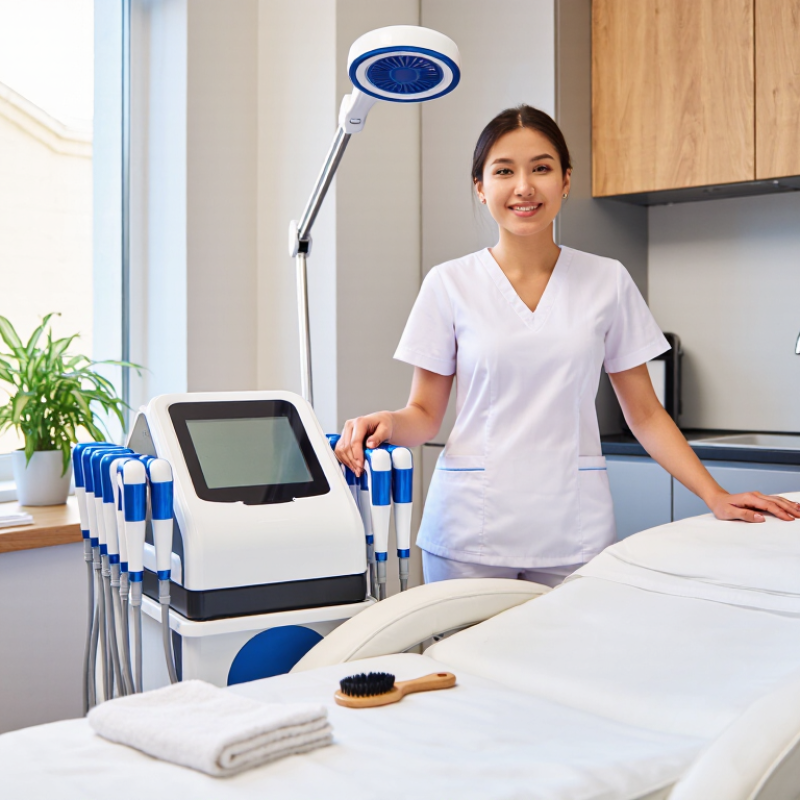
So, what should spa owners consider before buying facial machines? They should examine treatment goals, operator training, sanitation procedures, maintenance support, warranty terms, consumable costs, and realistic return on investment. Equipment should also carry appropriate safety documentation and meet relevant local requirements. Claims about skin improvement must remain evidence-based and professionally presented. A machine may look impressive in a demonstration, but real value appears after months of daily use. Some owners may overlook staff comfort or replacement parts, and that mistake can become expensive. The strongest choice is rarely the most advanced model. It is the machine that fits the spa’s clients, skills, room layout, budget, and service standards.
Define Spa Goals Using ISPA’s $21.3B U.S. Industry Revenue Data
What is the best facial machine for spa owners? The answer depends on measurable goals, not impressive specifications. ISPA’s reported $21.3 billion U.S. spa industry revenue shows strong demand, but revenue alone does not guarantee a wise purchase. Owners should study their local clients, treatment frequency, and available staff hours before choosing equipment.
A practical goal might be increasing express facials during weekday afternoons. Another could be improving customized treatments for mature skin or congestion. Each goal requires different functions, training, and maintenance. A machine should fit the treatment menu, room size, and consultation process. Ask how many appointments it can support weekly. Then calculate realistic payback using service prices, consumables, labor, and downtime.
Small details matter.
Can staff disinfect contact surfaces quickly between clients? Are instructions clear during a busy Saturday? Does the device allow adjustable intensity for sensitive skin? These questions support safer, more consistent service. Professional training and documented treatment protocols also strengthen client trust.
However, projections can be imperfect. A machine may look profitable on paper but remain unused if clients prefer shorter appointments. That mistake is easy to make. Owners should review booking data after ninety days and revise the plan. The best facial machine is the one that supports a clear business objective, fits proven client demand, and remains practical after the excitement fades.
Compare Hydrodermabrasion, RF, LED, IPL, and Microcurrent Technologies
What Is the Best Facial Machine for Spa Owners?
The best facial machine depends on your clients, services, budget, and staff training. In my experience, hydrodermabrasion suits clients wanting visible cleansing and smoother skin with little downtime. It combines exfoliation, suction, and solution infusion. RF technology delivers controlled heat, which may support firmer-looking skin. However, treatment comfort depends on temperature, skin sensitivity, and correct technique.
LED therapy
LED therapy is gentle and noninvasive. It can support calmer-looking skin and fits easily into many facial protocols. Results may appear subtle, so client expectations need careful management.
IPL
IPL can address selected pigmentation, redness, and unwanted hair concerns. It requires strict screening, protective measures, and trained operation, especially with darker skin tones.
Microcurrent
Microcurrent provides mild electrical stimulation and a temporary lifted appearance. Its effects can vary between clients.
Tips: Choose a machine after reviewing your treatment menu, room size, maintenance needs, and local training requirements. Ask suppliers for safety documents and practical demonstrations. Keep treatment records, including settings and client reactions. Never select IPL by price alone. RF also needs thoughtful screening for implanted devices and heat sensitivity. No machine wins every time. I still review results, because attractive technology can disappoint without consistent technique and aftercare.
Rank Machines by Evidence, Treatment Time, Results, and Client Demand
What Is the Best Facial Machine for Spa Owners?
Rank Machines by Evidence, Treatment Time, Results, and Client Demand
The strongest first choice is evidence-based LED photobiomodulation. Clinical reviews report improvements in selected acne and skin-aging concerns, but outcomes depend on wavelength, dosage, and regular use. Typical sessions take 10 to 20 minutes. That fits neatly under a mask, while staff prepare the next treatment. Results are gradual, not dramatic. Be honest about that.
A practical second choice is non-invasive microcurrent. Small clinical studies suggest temporary improvements in facial tone and appearance, yet the evidence remains less consistent than many sales claims suggest. Sessions commonly last 20 to 30 minutes. Ultrasound and gentle cleansing systems may rank third because they improve preparation and product application, although stronger long-term evidence is still needed. I would not rank novelty above research quality.
Client demand should influence the final score. The International Spa Association reported about 192 million U.S. spa visits in 2023, with average spending near 111 dollars per visit. That supports efficient add-on services. The International Society of Aesthetic Plastic Surgery also recorded millions of non-surgical aesthetic procedures globally in its 2023 survey, showing continued interest in low-downtime treatments. Demand matters. Measure it.
Before purchasing, run a 60-day trial. Track treatment minutes, repeat bookings, refunds, visible changes, and staff training time. Ask clients to rate comfort and perceived results. A beautiful machine can still underperform. The uncomfortable truth is that treatment consistency may matter more than hardware. Choose the device your team can operate correctly every day, not the one that looks most impressive in a showroom.
Check FDA Clearance, Esthetician Rules, Training, and Safety Standards
What Is the Best Facial Machine for Spa Owners?
Choosing a facial machine begins with clearance, not glossy demonstrations. In the United States, FDA 510(k) clearance means substantial equivalence to a legally marketed device. It does not guarantee every claim, setting, or spa result. Check the exact model, accessories, indications, and contraindications in the FDA database. The ISAPS 2023 Global Survey recorded 19,115,410 nonsurgical procedures worldwide. That demand encourages quick purchasing. It should encourage deeper scrutiny instead. A treatment menu is not a regulatory license.
Esthetician rules vary by state, province, and treatment type. Confirm whether the device requires medical supervision, additional certification, or restricted settings. Ask for structured training, competency checks, cleaning instructions, and emergency procedures. A rushed training session is not training. Look for electrical safety documentation aligned with IEC 60601-1 and risk controls informed by ISO 14971. Verify service intervals, operator logs, eye protection, and skin-cooling procedures. Even a compliant purchase can fail operationally. The weak point is often human, not hardware.
Tips: Request the clearance number before paying. Watch a live demonstration on a treatment chair. Test the emergency stop. Read the contraindications aloud with staff. Record training attendance and patch-test decisions. Do not copy online settings blindly. A lower energy level may still harm sensitive skin. Ask what happens after a customer reports blistering, burns, or unexpected pigmentation. The answer should be specific, documented, and practiced.
How to Evaluate a Facial Machine for a Spa
FDA device classification is based on intended use and risk. Class I devices are generally lower risk, Class II devices commonly require 510(k) clearance, and Class III devices generally require the highest level of premarket review, often through PMA.
Before purchasing, verify the exact intended use and model, confirm whether FDA clearance is applicable, check your state’s esthetician scope-of-practice rules, obtain documented operator training, and review electrical, sanitation, maintenance, and client-safety procedures.
Calculate ROI from Treatment Price, Utilization, Maintenance, and Lifespan
What Is the Best Facial Machine for Spa Owners?
The best facial machine is not always the most advanced one. It is the device that produces dependable returns. ISAPS reported 19.1 million nonsurgical aesthetic procedures worldwide in 2023. The Global Wellness Institute valued the global wellness economy at $6.3 trillion that year. These figures suggest strong market activity, but they cannot predict your local bookings. Local demand matters more.
Calculate contribution per treatment, not just revenue. Suppose a facial costs $140. Subtract $18 for consumables, $32 for labor, and $5 for payment fees. Your contribution becomes $85. If a $15,000 machine needs $2,000 for setup, lasts five years, and requires $1,200 yearly maintenance, annual equipment cost is about $4,600. At 20% utilization, one treatment daily creates roughly $22,440 in annual contribution across 264 operating days. That looks attractive.
But the spreadsheet is still incomplete. Rent, training, marketing, downtime, financing, and taxes can change the result. My first ROI estimate ignored idle hours. It looked impressive. It was not reliable. Track booked treatment hours against available hours each month. A machine operating at 20% utilization may need about 214 treatments to recover equipment and setup costs. Confirm the service schedule and realistic lifespan before buying. A cheaper device with frequent repairs may underperform a costlier device with stable uptime. Ask for maintenance records, warranty terms, and service response times. Numbers should challenge the purchase, not decorate it.
What Is the Best Facial Machine for Spa Owners? — Calculate ROI from Treatment Price, Utilization, Maintenance, and Lifespan
Planning comparison based on 300 operating days per year, one treatment room, and average utilization of available daily treatment capacity.
| Facial Machine Category |
Treatment Economics |
Ownership Costs |
ROI Results |
| Typical Treatment Price |
Daily Capacity |
Utilization |
Annual Treatments |
Purchase Cost |
Consumables per Treatment |
Annual Maintenance |
Expected Lifespan |
Annual Treatment Revenue |
Annual Operating Contribution |
Payback Period |
3-Year ROI |
| Ultrasonic Facial Unit |
$75 |
5 |
40% |
600 |
$3,000 |
$8 |
$450 |
5 years |
$45,000 |
$39,750 |
0.08 years |
3,875% |
| LED Phototherapy System |
$70 |
8 |
35% |
840 |
$7,000 |
$5 |
$700 |
5 years |
$58,800 |
$53,900 |
0.13 years |
2,210% |
| Microcurrent Facial System |
$95 |
5 |
45% |
675 |
$9,500 |
$10 |
$950 |
5 years |
$64,125 |
$56,425 |
0.17 years |
1,682% |
| Hydrodermabrasion System |
$135 |
5 |
50% |
750 |
$14,000 |
$22 |
$1,400 |
5 years |
$101,250 |
$83,350 |
0.17 years |
1,686% |
| Multifunction Facial Platform |
$155 |
6 |
45% |
810 |
$22,000 |
$28 |
$2,200 |
5 years |
$125,550 |
$100,670 |
0.22 years |
1,273% |
|
Calculation method: Annual treatments = daily capacity × utilization × 300 operating days.
Annual treatment revenue = annual treatments × treatment price.
Annual operating contribution = annual treatment revenue − consumables − annual maintenance.
Payback period = purchase cost ÷ annual operating contribution.
3-Year ROI = [(annual operating contribution × 3) − purchase cost] ÷ purchase cost × 100.
Labor, rent, utilities, taxes, financing costs, marketing, downtime, and other overhead are excluded.
|
Interpretation: The highest percentage ROI is not automatically the best purchasing decision. A spa should also consider treatment demand, staff training, service quality, room capacity, maintenance support, downtime risk, and whether the equipment can support premium pricing. The figures shown are market-reasonable planning assumptions for comparison and should be replaced with local pricing, actual utilization, and supplier quotations before purchase.
FAQS
Hydrodermabrasion combines exfoliation, suction, and solution infusion. It may provide a cleaner, smoother surface with little downtime. Results vary.
RF delivers controlled heat and may support firmer-looking skin. Comfort depends on temperature, sensitivity, and technique. Screen for heat sensitivity and implanted devices.
LED therapy is gentle and noninvasive. It can support calmer-looking skin and fit many facial routines. Changes may be subtle.
IPL may address selected pigmentation, redness, or unwanted hair concerns. It requires careful screening, protective measures, and trained operation. Darker skin tones need special attention.
Microcurrent provides mild electrical stimulation and may create a temporary lifted appearance. Effects differ between clients. Avoid promising permanent changes.
Review your treatment menu, room size, maintenance needs, budget, and staff skills. Ask for safety documents and a practical demonstration. A polished demonstration can still mislead.
Check the exact clearance, accessories, intended uses, and contraindications. In the United States, 510(k) clearance indicates substantial equivalence. It does not guarantee every advertised result.
Confirm local esthetician rules, supervision requirements, certifications, and restricted settings. Staff should practice emergency stops, cleaning, eye protection, and skin cooling. Training matters.
Record settings, skin reactions, patch-test decisions, and treatment dates. Keep attendance records for staff training. Review outcomes honestly, because technique can weaken good technology.
Conclusion
Choosing the best facial machine for a spa begins with defining clear business goals and understanding local client demand. The U.S. spa industry’s reported $21.3 billion revenue highlights the opportunity, but success depends on selecting equipment that matches your services, budget, staff expertise, and treatment capacity. Spa owners should compare hydrodermabrasion, radiofrequency, LED, IPL, and microcurrent technologies according to clinical evidence, treatment time, visible results, comfort, and repeat-visit potential. Asking “what should spa owners consider before buying facial machines” can help create a practical evaluation checklist before making a purchase.
Safety and profitability are equally important. Owners should verify FDA clearance where applicable, follow regional esthetician regulations, confirm training requirements, and establish proper sanitation and operating procedures. A realistic ROI calculation should include treatment pricing, expected utilization, consumables, maintenance, staff training, warranties, and equipment lifespan. The strongest choice is not always the most advanced machine, but the one that can be used safely, consistently, and profitably while delivering results clients value.

 Biology Skincare